Edit

Forehead Lines

Advanced Treatments for Forehead Wrinkle Correction

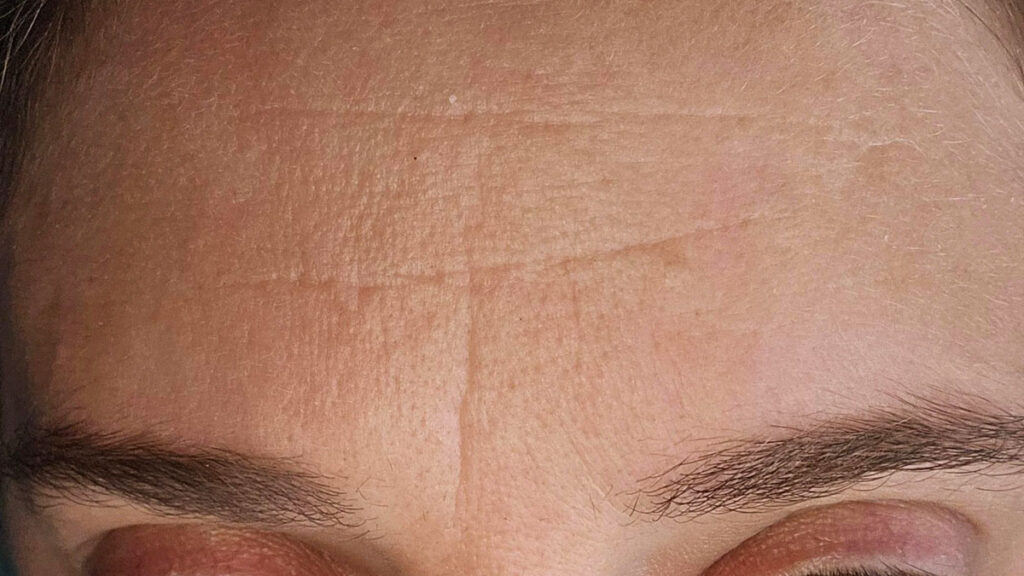
Forehead lines often appear as one of the first signs of aging, revealing years of facial expressions and environmental exposure. Skin loses collagen and elasticity over time, making these lines more noticeable each year. Repeated movements, like raising eyebrows or frowning, deepen these creases, contributing to their permanence.

For women between 30 and 60, these changes can feel discouraging. Fine lines that were once temporary may linger throughout the day, creating concerns about appearance and skin health. Understanding why these wrinkles form and exploring practical ways to soften them can make all the difference in maintaining a youthful, refreshed look.

Key Takeaways

  • Forehead lines develop from frontalis muscle contractions and declining collagen production, transitioning from dynamic to static around age 30.
  • Collagen density decreases 1-2% annually from age 25, making skin unable to bounce back from repeated expression lines.
  • Professional treatments include volume restoration, advanced microneedling, and chemical peels for comprehensive wrinkle correction.
  • TCA and Jessner peels can achieve 40-50% wrinkle depth reduction whilst stimulating lasting collagen improvement.
  • Beauty Booster treatments provide immediate smoothing plus long-term skin quality enhancement for forehead concerns.

Why do Forehead Lines form?

Forehead lines primarily develop due to the following factors:

  1. Muscle movement: The frontalis muscle, which spans the forehead from the eyebrows to the hairline, raises the eyebrows. Repeated contractions of this muscle over time lead to the formation of horizontal lines, which can be softened with wrinkle reducing treatments.
  2. Aging process: As we age, our skin loses collagen and elastin, essential proteins that maintain skin firmness and elasticity. This natural decline reduces the skin’s ability to bounce back after facial expressions, contributing to the formation of wrinkles.
  3. UV exposure: Excessive sun exposure accelerates aging by breaking down collagen, leading to premature wrinkle formation.
  4. Genetics: Due to their genetic makeup, some individuals are naturally more susceptible to developing facial lines, including those on the forehead.
  5. Repetitive facial expressions: Frequent eyebrow raising, especially when expressing surprise or concern, can cause lines to become more pronounced over time.
  6. Lifestyle factors: Smoking reduces blood flow to the skin, depriving it of nutrients and increasing susceptibility to wrinkles. Additionally, a diet high in simple sugars can contribute to the loss of skin elasticity through a process called glycation.
  7. Environmental factors: Exposure to pollutants and other environmental stressors can accelerate skin aging and wrinkle formation.

The Role of the Frontalis Muscle in Dynamic Wrinkle Creation

The frontalis muscle, a thin, vertically oriented muscle spanning the forehead, is the primary driver of forehead line formation. This muscle contracts to elevate the eyebrows, creating horizontal skin folds during expressions such as surprise, curiosity, or concern.

In youth, the skin’s robust collagen and elastin networks allow it to rebound smoothly after muscle relaxation. However, with repeated contractions over decades, the cumulative mechanical stress induces microtrauma to the dermal matrix. Each contraction generates shear forces that disrupt collagen fibrils and elastin fibers, gradually reducing the skin’s ability to return to its original state.

Transition from Dynamic to Static Wrinkles

Initially, forehead lines appear only during muscle activation (dynamic wrinkles), in the same way that crow's feet lines form at the outer corners of the eyes. Around the third decade, the skin’s regenerative capacity declines, and these temporary folds begin leaving residual creases at rest.

This transition to static wrinkles correlates with histopathological changes: cross-sectional studies show a 1-2% annual reduction in dermal collagen density starting at age 25, accelerating to 3-5% per year post-menopause.

The degradation of type I and III collagen, critical for tensile strength, leaves the skin structurally compromised, allowing gravitational forces to deepen existing lines.

What are the best treatments for deep forehead lines?

For deep forehead lines, The Cosmetic Studio Noosa offers several effective treatments:

Genius RF Microneedling

Genius RF Microneedling combines traditional microneedling with radiofrequency energy to address skin concerns, including fine lines and forehead wrinkles.

The treatment delivers controlled heat through micro-needles into precise dermal layers of the skin, stimulating collagen and elastin production. This process helps improve skin texture, reduce the appearance of wrinkles, and tighten the skin.

Beauty Booster

Beauty Booster combines a rejuvenation treatment with vitamins and amino acids to improve skin texture, reduce fine lines, and enhance overall skin quality, making it an excellent treatment option for Forehead lines.

TCA Peels

TCA peels at 20-35% concentrations induce controlled protein denaturation up to the papillary dermis. This eliminates photoaged keratinocytes while upregulating MMP-2 and TIMP-1 to reorganise collagen bundles. Combined with pre-peel retinoid priming, TCA achieves 40-50% wrinkle depth reduction in 1-2 sessions.

Jessner Peel

The blended Jessner peel formula provides epidermolytic action without requiring neutralisation.

Are you unsure which treatment will suit you best? Our Registered Nurses are here to help! Book a consultation today and start your journey to a newer you.

Frequently Asked Questions

Learn More

Here are some FAQ's about Forehead Lines. If you have any other questions, please give us a call or request a Consultation today.

Forehead lines in your 20s are more common than you might think, and they are not necessarily a sign that something is wrong.

The most common cause in younger people is repeated facial expression. The frontalis muscle raises the eyebrows and creates horizontal lines across the forehead every time it contracts. In people who have naturally expressive faces or habitually raise their eyebrows, these lines can begin to etch into the skin earlier.

Sun damage is another significant contributor, particularly in Australia. UV exposure accelerates collagen breakdown and skin ageing, meaning people with a history of sun exposure without adequate protection may notice lines earlier than their peers.

Genetics and skin type also play a role. Fairer skin types tend to show fine lines earlier, and a family history of early wrinkles is a reasonable predictor.

If you are noticing forehead lines in your 20s, the most effective steps are daily SPF 50+, a skincare routine that includes collagen-supporting ingredients, and a consultation with one of our registered nurses to discuss whether early preventive treatment is appropriate for your situation.

Yes, everyone develops forehead creases when raising their eyebrows. These are known as dynamic wrinkles because they appear during facial movement and are caused by the frontalis muscle contracting.

The frontalis spans the entire forehead from the eyebrows to the hairline. When it contracts to lift the brows, it pulls the skin upward and creates the characteristic horizontal lines. This is a completely normal part of facial expression and allows us to convey emotions such as surprise, curiosity or concern.

The frontalis is the only muscle capable of raising the eyebrows, so these lines are an unavoidable byproduct of normal facial movement. What varies between people is how visible these lines remain once the expression relaxes, and how quickly they transition from dynamic to static lines that are visible at rest.

The transition from dynamic to static forehead lines typically begins around the age of 30, though this varies considerably between individuals.

Dynamic lines appear only during expression and fully disappear at rest. Static lines remain visible on the skin even when the face is completely relaxed, because the skin has lost enough elasticity that it can no longer fully spring back from repeated muscle contractions.

The shift is driven by declining collagen production, which begins in the mid-twenties and accelerates gradually with age. As the skin becomes thinner and less resilient, the creases created by repeated frontalis movement become more permanently etched.

UV exposure, genetics and lifestyle factors all influence when and how pronounced this transition is. Early preventive treatment can delay the transition significantly by reducing muscle activity before static lines become established.

Some degree of forehead line development is a natural part of ageing and expression, but their severity and timing can be meaningfully influenced.

Daily SPF 50+ is the most important single preventive measure. UV exposure is one of the primary drivers of premature skin ageing, and consistent protection slows the collagen breakdown that allows dynamic lines to become static.

A good skincare routine that includes collagen-supporting ingredients such as retinol and antioxidants helps maintain skin quality and resilience over time.

Early professional treatment can also be genuinely preventive. Addressing muscle activity before lines become static is significantly more straightforward than treating well-established creases. Many clients start preventive treatments in their late 20s or early 30s to slow the progression rather than waiting for lines to become a more prominent concern.

A consultation with one of our registered nurses will help you understand your individual risk factors and determine the most appropriate preventive approach for your skin.

The distinction between dynamic and static forehead lines is important because they respond differently to treatment.

Dynamic lines appear only when the frontalis muscle is active and disappear completely at rest. These respond very well to muscle-relaxing treatment, which reduces the frequency and intensity of the contractions that create the lines. When addressed early, before the lines become static, muscle-relaxing treatment can prevent them from becoming permanently etched.

Static lines are visible even when the face is at rest, because the skin has lost its ability to fully recover from repeated muscle movement. These typically require a combination approach. Muscle-relaxing treatment reduces further progression, while collagen-stimulating treatments such as skin needling and RF microneedling address the structural changes in the skin. Volume restoration may also be used where significant thinning or hollowing has occurred.

Your nurse will assess whether your forehead lines are primarily dynamic, static or a combination of both, and recommend the treatment approach that best suits your skin and goals.

Longevity varies depending on the treatment used.

Muscle-relaxing treatments typically last three to four months. With regular maintenance over time, many clients find that results last slightly longer as the muscle adapts to reduced activity and lines soften.

Volume restoration in the forehead area, where used to address significant hollowing or deep static creases, typically lasts nine to eighteen months depending on the product used and individual metabolism.

Collagen-stimulating treatments such as skin needling and RF microneedling deliver progressive improvement that builds over six to twelve weeks, with results that can last significantly longer as the skin’s structural support improves.

Skin resurfacing treatments such as chemical peels improve texture and surface quality, with results that depend on the depth of the peel and how well the skin is protected afterwards.

Combination approaches that address multiple factors tend to deliver the most comprehensive and lasting results. Your nurse will outline a realistic timeline for each component at your consultation.

Yes, and in many ways younger patients are ideal candidates for early preventive treatment.

In clients in their 20s and early 30s, forehead lines are typically still dynamic, meaning they appear with expression but disappear at rest. At this stage, muscle-relaxing treatment is often sufficient on its own, and addressing lines before they become static is significantly more effective than treating them after they are established.

The goal in younger patients is usually prevention and maintenance rather than correction. Reducing the frequency and intensity of frontalis contractions slows the progression from dynamic to static lines and preserves skin quality.

In older patients where both muscle activity and structural skin changes are present, a combination approach that addresses muscle activity, skin quality and volume is typically more appropriate.

Your nurse will assess your specific situation and recommend the most appropriate starting point for your age, skin condition and goals.

Concerned about forehead lines affecting your appearance?

Our experienced registered nurses will assess your specific line patterns and skin condition to create a personalised treatment plan addressing both muscle activity and skin quality. Book your consultation today to discover the most effective approach for your forehead concerns.